
🚀 Getting Started with Infrastructure as Code (IaC): A Platform Engineer’s Guide
Hey there, Platform Engineers! 👷♀️👷♂️
Welcome to your go-to guide on Infrastructure as Code (IaC), a foundational practice for scalable, secure, and efficient infrastructure management.
If you’ve ever found yourself thinking “There has to be a better way to manage this infrastructure…” — you’re absolutely right. Welcome to the world of Infrastructure as Code (IaC)! 🧑💻💻
This post is your 🔑 to understanding what IaC is, why it matters, and how to choose the right tool for the job.
📘 What is Infrastructure as Code (IaC)?
Infrastructure as Code is the practice of managing and provisioning cloud infrastructure using code instead of manual processes. Instead of clicking around cloud dashboards (yikes 😬), you define infrastructure like virtual machines, networks, storage, and more, all in code!
Think of IaC as treating your infrastructure the same way you treat application code: you write it, version it, test it, and deploy it using best practices from the world of software engineering.
🧠 Why is IaC Essential for Platform Engineering?
As a platform engineer, you’re often responsible for creating scalable, reliable, and repeatable systems that other teams build on. IaC provides a systematic, scalable, and repeatable approach to managing that foundation.
- 🛠️ Standardization: Ensure consistent environments across dev, staging, and prod.
- 🧪 Testability: Validate changes in CI pipelines before applying them.
- 🔁 Repeatability: Spin up identical environments on demand.
- 🔒 Security: Apply policies-as-code and audit changes via Git history.
- 🔧 Troubleshooting: Roll back to a previous known-good state.
- 📦 Reusability: Package common infra patterns as reusable modules for your team.
IaC helps platform engineers do more with less, move faster with fewer errors, and build platforms that scale, both technically and organizationally.
✅ The Benefits of IaC
Let’s break down why adopting Infrastructure as Code (IaC) is a no-brainer for modern platform engineering:
| Benefit | Description |
|---|---|
| 🤖 Automation | Say goodbye to manual clicks — deploy entire environments with a single command. |
| 📏 Consistency | Ensure environments look the same every time, across dev, staging, and prod. |
| 🕓 Speed | Spin up resources in minutes, not hours or days. |
| 📝 Version Control | Store your infrastructure code in Git, track changes, and roll back safely. |
| 🧩 Modularity | Create reusable modules to speed up future projects. |
IaC makes your infrastructure reliable, scalable, and manageable, just like any good piece of software.
🔁 Declarative vs. Imperative IaC
There are two main philosophies in the IaC world:
📜 Declarative (What to achieve)
You define the desired state of your infrastructure. The tool figures out how to get there.
Example: “I want a VM in region X with Y GB of RAM.”
- Tools: Terraform, OpenTofu, Bicep
✅ Easier to maintain
✅ Better for drift detection
✅ Tools: Terraform, Bicep, OpenTofu
🧮 Imperative (How to achieve it)
You write step-by-step instructions to build infrastructure.
Example: “Create a resource group, then create a VM, then install nginx.”
- Tools: Pulumi, Ansible, scripting (e.g., Bash or Python)
✅ More control
✅ Familiar for software developers
✅ Tools: Pulumi (with code), Ansible (scripts)
🛠️ Popular IaC Tools (and When to Use Them)
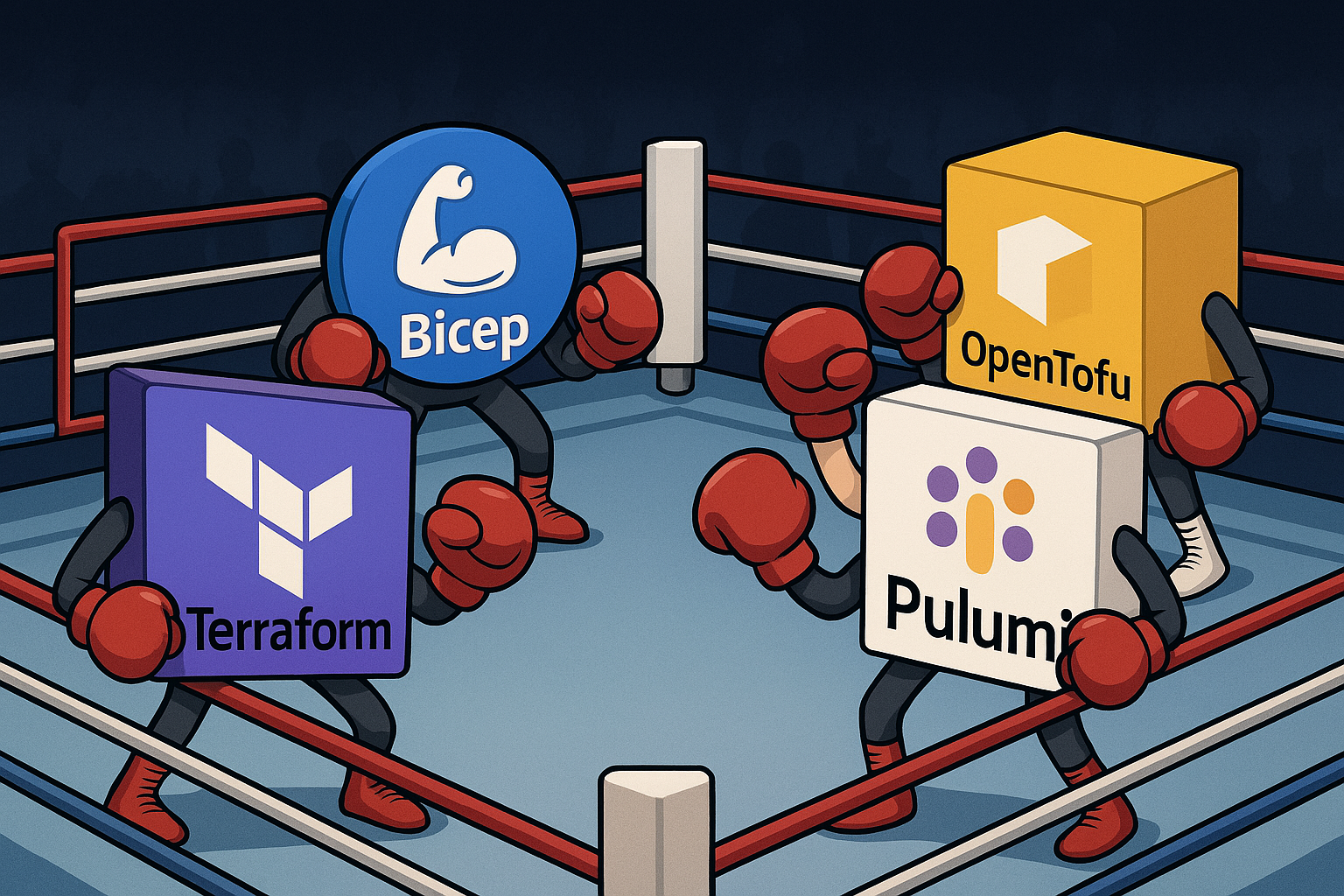
Choosing an IaC tool is a bit like building a table: 🪑🔨
You wouldn’t build a table using just a hammer, right? You need different tools for different parts. A saw to cut, a drill to assemble, a level to make sure it’s even.
The same applies to Infrastructure as Code. There’s no single “best” tool, but rather the right tool for the job depending on your use case, team skills, and cloud ecosystem.
Let’s break it down:
🌍 Terraform

- Type: Declarative
- Language: HCL (HashiCorp Configuration Language)
- Strengths: Mature ecosystem, vast provider support, cloud-agnostic, strong community, modular structure
🧰 When to Use Terraform
Use Terraform when you want a reliable, cross-cloud workhorse. It’s like your electric drill, versatile, powerful, and works with many attachments (cloud providers). Perfect for teams who want standardization across AWS, Azure, GCP, and more.
🌍 Ideal for
- Multi-cloud or hybrid environments
- Teams looking for a well-documented and widely adopted tool
- Creating reusable modules for consistent infrastructure patterns
🌱 OpenTofu

- Type: Declarative
- Language: HCL (Terraform-compatible)
- Strengths: Fully open-source, community-driven, no licensing constraints
🧰 When to Use OpenTofu
Think of OpenTofu as your open-source screwdriver, simple, familiar, and doesn’t lock you into a specific brand. Great for teams who love Terraform but want to avoid proprietary licensing or maintain full control over the source code.
🌱 Ideal for
- Open-source enthusiasts and contributors
- Companies with strict OSS or compliance requirements
- Projects where long-term cost and transparency matter
🧑💻 Pulumi

- Type: Imperative
- Language: TypeScript, Python, Go, .NET, Java
- Strengths: Developer-friendly, integrates directly with programming languages, great for complex logic
🧰 When to Use Pulumi
Pulumi is your smart multi-tool, think Swiss Army knife 🧠. Ideal when you’re building a custom setup and need to blend infrastructure with real code. For instance, looping over dynamic data, embedding conditionals, or integrating APIs directly within your IaC logic.
💡 Ideal for
- Developers who want to write infra using the same language as their apps
- Complex applications with lots of conditional resources or dynamic behavior
- Teams already working in modern CI/CD pipelines and want full code integration
🧱 Bicep

- Type: Declarative
- Language: Bicep (DSL for Azure ARM templates)
- Strengths: First-class Azure support, ARM simplification, clean syntax
🧰 When to Use Bicep
Bicep is like your precision chisel, tailor-made for a specific platform (Azure). It simplifies complex Azure templates, and offers tight native integration, like Azure Policy, RBAC, and Resource Groups. Perfect for teams fully committed to the Azure ecosystem.
🧱 Ideal for
- Azure-native environments
- Teams that want to move away from verbose ARM templates
- Projects that need native integration with Azure DevOps or Microsoft governance tools
🧭 Summary: Use the Right Tool for the Job
| Tool | Type | Best For |
|---|---|---|
| Terraform | Declarative | Multi-cloud, modular infra, community plugins |
| OpenTofu | Declarative | Open-source purists, cost-sensitive projects |
| Pulumi | Imperative | Developers, dynamic infra, advanced logic |
| Bicep | Declarative | Azure-native teams, simpler ARM replacements |
No single tool does it all, just like building a table, pick the right tools from your IaC toolbox 🧰 to make the process smooth, efficient, and tailored to your needs.
Ready to build your platform masterpiece? Pick your tools and start crafting! 🏗️💻
🎉 Final Thoughts
Infrastructure as Code is a must-have for modern platform engineering. It brings speed, consistency, and peace of mind 😌 to infrastructure management.
No matter where you are on your IaC journey, the tools and approaches above are ready to empower you to build better platforms, faster and safer 🚧⚡